Sunday, April 13, 2014

A Busy Week in Devon

At first, it didn't seem as though Devon had as many interesting houses to visit as some of the other regions.  And then, we went to Coleton Fishacre. Strange name for a positively lovely house.

This house was built specifically for the D'Oyly Carte family of theatre fame. They bought up the rights to all of the Gilbert and Sullivan plays and put on several of them each season.  They also bought almost every high end hotel in London which produced enough income to build this house and still have a fortune left over.


They had the right idea when they designed this house.  It was immensely livable.  Even just to walk through, one could feel like a weekend guest.  The rooms were comfortable, the house had central heat (still not all that common in the 1930s), it had lovely gardens and it was in a peaceful setting with just short walk down the cliff to the beach.

What was not to like about this?  Only the fact that it was so close and yet so far away.  It seemed to take forever to get there because of the long one-lane road and then a very long narrow driveway.  What a gem once we got there.


It was such a pleasure to visit a house that was in good condition and had most of the rooms open to the public.  I find it disappointing to go to a huge manor house or castle and just have the great room and the kitchens and stables open.  I'd rather be able to see the other rooms even if they are not ready for prime time. 

This room was so inviting.  Just as we entered, a young boy was playing the piano (very well) which is at the far end of the room. At many of these houses, "confident amateurs" are encouraged to sit down and play.  That just astonishes me because I have never yet been to a house in the US where anyone could play the piano.


In this mildly Art Deco styled house, I could swear that I could just picture Cole Porter and his gang sitting around, talking, drinking, smoking and most of all playing the piano.

~~~

Fans of Miss Marple, Inspector Poirot and Mousetrap can absorb some of the aura of Agatha Christie at her summer home, called Greenway -- named after the village nearby.  The family's furniture and eclectic collections are still there, presumably as they left them.  This sitting room looks like Christie just went to the kitchen for tea and will be back presently.


This is such a great summer house.  It has windows and doors in just the right places for catching the summer breezes coming up from the river below.


These lounge chairs were so inviting that visitors took turns sitting in them and having their picnic lunch.


~~~
A couple of days ago, we went to a house, Castle Drogo, which was built by a wealthy merchant who retired at age 33 to be a family man and country gentleman.  A self-made man who really enjoyed his wealth.

Then, we went to this house, Knightshayes.  The builder of this high Victorian country home could not have been more different from the merchant.  This owner was the grandson of the man who started a lace mill business and lived a modest, respectful life.  Then the son inherited the lace business and also lived a relatively quiet, respectful life running the business.  Then, the grandson came along and he decided that he did not want any part of running a lace mill. He wanted to hunt, shoot, have parties and live in a big, extravagant house.  And so he did. 


This was definitely a lavish house worthy of the lifestyle that he was hoping for. 

Of all of the houses that we have visited so far, this had the best location. The drive up to the house was impressive.  The outbuildings were placed so that they did not in any way detract from the house itself.

In front of the house were terraces, each in full bloom with tulips, daffodils and colorful ground cover.  There was also the largest kitchen garden of any of the 300+ properties owned by the National Trust.

One unusual thing about this house is that photos were not allowed inside of the house.  The normal reason for this would be to keep the light level down to protect fabrics and artwork, but that did not seem reasonable here because the drapes were open and the sunlight (yes, finally sun!) was streaming in.  

Most often, visitors are cautioned just to not use flash inside of the house and that keeps the light down.  And, certainly, we visited quite a few houses which were more important in terms of national history or the delicate nature of the furnishings. So, we have no interior shots.  

When I viewed my photos of the day later on that evening, I noticed that I had inadvertently taken several photos of the floor!  I guess that I didn't turn the camera off and that I kept hitting the button by mistake.  


~~~
This is the oldest house in Devon that we visited, called Cotehele (pronounced Cote-heel).  This is an Elizabethan era house but of course, like most houses, it was built over the years, a section at a time.  In this photo, you can actually see the different types of stonework indicating an addition.


It's amazing how builders were able to add on, substract from, and generally modify the buildings.  Some buildings have evidence of old windows blocked up, and some "new" windows not quite matching the stones of the rest of the house.

The great thing about this house is this!


Just look at all of that armor and the high ceiling.  This room was, to my mind, magnificent.  It was also chilly because this house has never been modernized. There's no central heat and there might not be any plumbing.  There is minimal electricity to run a few lights, so as not to use candles, and also to run the alarm system that every property has.

One way that the residents of this house chased away the chills was to have large fireplaces in each room.  If the room was large enough, there might be two fireplaces.  They also hung tapestries on the walls and covering the doors to catch drafts.  This house still had the original tapestries, in reasonably good shape considering their age.  Every wall surface of the private rooms was covered with tapestries.  I have never seen so many.  The odd thing is that they must have used tapestries from other places because they were cut and pieced to fit with no regard for how the pieces fit into the scene depicted. Thrifty, these 16th century rich folks!


I'm always interested more in the later generations who lived in the properties than the original owners.  I'm interested in how the family came to give up a large house and estate that has been in the family for maybe 600 years.  I would not want to be the last generation to own these places -- the one to always be known as the one who couldn't keep it up and had to give it away. 

So, as usual, I asked the room guides about the last owners and I got quite a surprise.  The owners, sometime in the  1500s or early 1600s got even richer and felt that this huge house was not big or fancy enough to represent their wealth, so they built an even larger home and used this as their "summer home".  They only used it for entertaining guests.  Since there were no further permanent residents of the house, it never really got a facelift.  Evidently that armor on the wall has been hanging there ever since it was first put there. Amazing.

This house was like a time capsule.

~~~

Friday, April 11, 2014

A Man's Home is his Castle


We left Penzance and Cornwall and drove back east a bit into Devon, through the moor.  The moor is an interesting place in that there is just about nothing there. There are a few farms on the edge of it and a tiny village here and there wherever there is a road through, but for the most part, there is just nothing there.  

Well, nothing unless you count gorse.  There's a lot of gorse. You remember gorse, right? It's what Eyore loved to eat.  It's thorny, rough, slightly woody and has yellow flowers which actually look rather nice when viewed from a distance.


                  photo credit: www.rspb.org.uk

I read on line that plant companies actually sell gorse as a hedging.  It would be great for keeping kids out.

~~~

We had some time to kill before checking in at our next "holiday let" so we used our membership cards to go to the last working water driven forge in the country. Unbeknownst (that's a great British word!) to us, Finch Forge was celebrating its 200th anniversary as a forge that day.  Previously, it had been a woolen mill.  The mill used a water wheel for power coming from a nearby spring.  It's amazing how much power can be harnessed from a relatively small water source.  


They had a small community band, called a silver band because all of the instruments were silver instead of brass.  


They also had demonstrations going on during the day, including this guy who is a nearby mostly retired blacksmith. 


He was adeptly making some decorative iron snails.  He had a bit of a gift of gab and seemed to really be enjoying himself, answering questions from his audience of curious watchers.

~~~

In Devon, we have continued our tour of National Trust properties, including this one:  Castle Drogo.  It is the last castle built in England (so far), being finished in 1930, built by a wealthy tea merchant and grocer.  He made an incredible amount of money early in his career.  By the time that he was 33 years old, he decided that he would retire to spend the rest of his life being a country gentleman.  He sold 75% of his company and lived very well on the dividends from his remaining shares.


Even though there are castles, parts of which were built 600 years ago or more, still standing and in reasonably good repair, this castle was a decade away from total ruin when the Trust began a multi-million pound project to repair the roof, leaking windows and water damaged walls.  

The flat roof was not a good design feature.  Just about any thinking person would know that. His architect warned him, but he wanted "authenticity".  I've seen a few castles by now and none of them had flat roofs (and lived to tell about it).  

The contractor is removing all of the large stones from the roof, making it water tight, putting down a waterproof layer, then gravel, then the original granite stone blocks and also removing the 900+ windows and fixing them.  

The whole project will take upwards of 10 years.  In the meantime, all of the furniture, carpets, paintings and household items have been packed in crates and await the reopening. The whole place looks like they are just waiting for the moving vans to arrive.  


Castle Drogo did have its garden still in tact.  The daffodils are almost gone now, but the good news is that it is now tulip time.  Everywhere we look there are many, many varieties of tulips to delight the eye.

~~~

Wednesday, April 9, 2014

Leaving Cornwall

One day, while the mist was particularly thick, we decided to do something a bit different.  We went to a Roman ruin, approximately 1st century.  It is estimated to be that old because it was of the iron age (800 BC to 100 AD), the later years of which coincided with Roman settlements (or should I say occupation?). There are now around 100 Iron Age sites that have been discovered in Great Britain.  

I'm somewhat interested in the growth of the Roman Empire and I've read about it off and on over the years.  At a bookstore in London, I saw a tourist map of Great Britain organized by Roman name places with sites of interest noted.  Had we not already planned our trip, I would have been tempted to do the Roman route.

The site that we visited is called Chysauster.  It has a great view from near the crest of the hill for about 10 miles down to the sea.  No one could get a jump on them, unless of course it was a pea-soup foggy day like the day that we were there.  We couldn't see a football field away.  

Unfortunately, it's a bit difficult to take meaningful photos of ruins, because they basically just look like piles of rocks.  But, here's an attempt to show the site.


These are rooms within a circular house.   The houses were built with rooms or enclosures surrounding a central open area.  There would be a center pole to hold up the roof which would extend across to the exterior wall.


At this site, there were eight houses, spread over the area, plus some other buildings which were probably enclosed areas for the animals and supplies.

--

While in Cornwall we stayed in a small, but very crowded and very busy fishing village right next to Penzance.  It was high up on a hill which directly abutted the waterfront.  That made for an "interesting" climb up the narrow road with the buildings on one side and the cliff immediately on the other side.  After a week of driving back and forth, I got very used to it and could zip around like a local, but my first time up that hill was tricky.

Here's a photo from the front step of our apartment.  It gives a suggestion of the height of the road.


The town where we stayed, Newlyn, is home to the largest fishing fleet in the country and this port provides nearly all of the fish sold in England.  There are other fishing ports, but this is by far the busiest.

Penzance is about half way around the large bay.  It and the other towns and villages around cater to the tourist business.  "Holiday lets" abound.  In fact, just about the total southern shore of Cornwall and Devon is all a tourist destination. Being that we are here in the shoulder season, there are plenty of tourists around but the streets are not clogged with them.

Across the bay from our cottage rental is St. Michael's Mount.  Sounds remarkably like Mont St Michel?  There's a reason for that.  The French brothers found a similar rock in the harbor here and started another monastery.  The two monasteries were linked for a couple of centuries until the one here in the bay was sold for 800 pounds Sterling, which must have been pretty close to the whole of the treasury at the time.   


The property is now under the care of the National Trust, although (like many of the NT properties) part of the family still lives there.  The castle is open to any of the public that wants to pay the fee and can climb up the punishing rock access road.  I use the term "road" very loosely.  It is a steep ox-cart type road with rocks set in on an angle, making a very difficult climb.


To my astonishment, the family has no other access other than this same path.  I can't imagine them leaving very often.  Going for groceries must be a chore.  They probably have help that do those chores for them, but you can't send someone else to get a haircut for you.

At high tide, the Mount becomes an island and it is necessary to take a ferry. Here's a photo from the top with the tide about to return.


--

We've been to quite a few of the National Trust properties by now, and by far, Lanhydrock is one of my favorites.  It is a lovely house, in very good condition and fully furnished.  It has this gorgeous gate house, not the least bit crumbling.


The rooms were all set up as they would have been when the family was still there. I believe that this is one house where the family is no longer in residence.


Although it is interesting to see houses that are in a state of repair or reconstruction, it is also very nice to see houses that have been kept in good condition by the successive families.  This one is a gem.

--

It's our last day in Cornwall and we are treated to lovely sunshine.  We've had a lot of fog, mist, clouds and some outright rain this week, but this day is beautiful.

We decided to take a drive down to the southern most point in Great Britain, a section of the country called The Lizard.  I have no idea why it has that name. I haven't seen any explanation.  The drive turned out to be quite a bit longer than it appeared on the map, but it was a nice drive.  

The National Trust owns approximately one tenth of the total coastline of England, Scotland, Wales and Northern Ireland.  That's a lot of coastline under their protection from development.  Part of their holdings is the coastline of The Lizard.  At the point there is a rather nondescript lighthouse over the rock cliff:


It also has the remains of a defunct life saving station.  The boat house and ramp are shown here.


The shoreline all around here is extremely treacherous and has claimed many ships over time with much loss of life.


We had our picnic on a bench overlooking the rocks.  It reminded me of Pemaquid and I temporarily felt a bit homesick.  The drive back to the main road was the usual one lane, banks high up on both sides, twisty/turny, can't see ahead kind of road.  I'm getting used to them. 

Tuesday, April 8, 2014

Land of Make Believe

OK, British TV fans, do you recognize this rugged coastal village from a few seasons back?  


No? Can't place it?


Does this look familiar?


Yup, Doc Martin's adopted town of "Port Wenn", known to those who live here as Port Isaac.  There were lots of people taking the same photos, everyone trying to look so nonchalant, as if it was just any house.  A local on his way to celebrate the birth of a new resident stopped long enough to snap our photo:


There was an organized tour for Doc Martin fans to point out all of the filming sites, but not while we were there (and I would not spring for the cash anyway), so we just walked around town with the other fans and soaked up the atmosphere.  Quite surprisingly, the town was not really capitalizing on its recent fame.  It definitely is a quaint Cornwall village complete with steep hills, deep gouges ripped out of the ocean side, impossibly narrow, winding lanes barely wide enough to squeeze a car through, doorsteps that open directly onto the lane, car parks on the outskirts of the village and spring flowers everywhere. 

It was quite far off the beaten path, but worth the trip.  Of course, there are dozens of picturesque villages dotting the northern coast of Cornwall; any one of them would be a great place to stop for tea and a biscuit. 


As I was driving along the way to Port Isaac, I saw a large billboard type sign (by the way, the English do not have billboards and I have not missed them one bit) that called attention to the area as being the setting for the Poldark series.  That series was on TV so long ago that I had totally forgotten about it. I didn't see anything else about it, so I'm guessing that maybe when the show was popular about three decades ago, there was some tourist activity.

While on a quest to see make-believe places, we also stopped a few miles up the road to see Tintagel, legendary home of King Arthur.  It turns out that the castle is in such total ruins that it is just a pile of rocks here and there.  Larry had seen it on a trip he made with his family before we were married, and I'm not much on King Arthur lore, so I decided to skip that particular oddity.  

Instead, we visited an old post office in Tintagel.  Like a lot of buildings, it was built in stages over a few centuries.  It is truly amazing how many buildings are still standing that were originally started 400 years ago (or more!).  This hearth is part of the original house which later became the post office.


This chair and another one very similar were made in the 1600's and were being used until this property was given to the National Trust.  They were in remarkably good condition.  Against one wall there was a bench with a back, called a "settle", built in 1620 and visitors were invited to sit on it, if they wished.  Hard to believe.


Although this photo doesn't really show it very well, the very old roof rippled like ocean waves.  It had sagged in a few places and the tiles just settled in and kept on going.


The post office had the most delightful little garden in the back, a great place to sit and rest.

Thursday, April 3, 2014

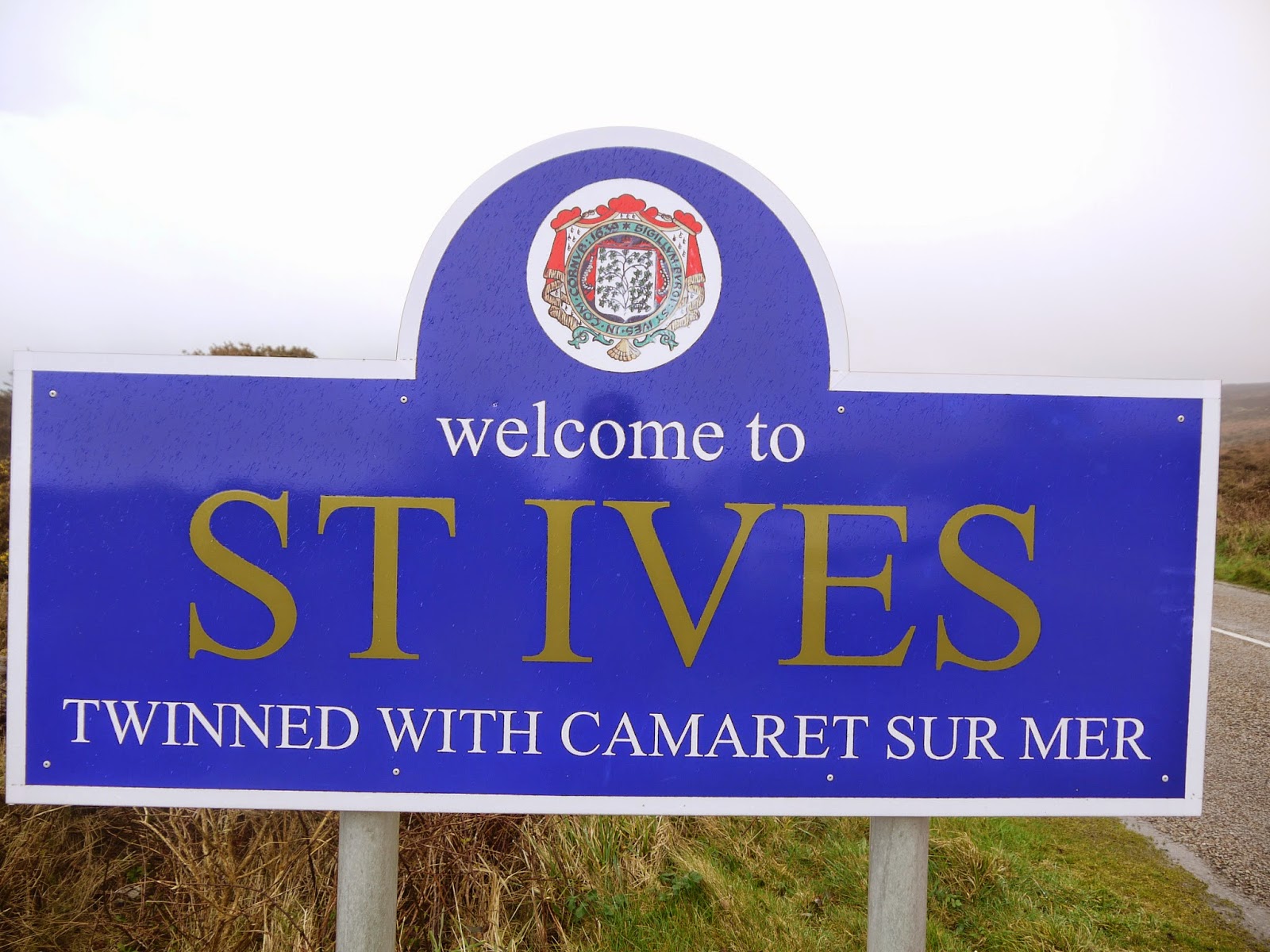
As I was going to St Ives . . . .


As I was going to St Ives
I met a man with seven wives
Each wife had seven sacks
Each sack had seven cats
Each cat had seven kits
Kits, cats, sacks, wives
How many were going to St Ives? 


We didn't meet the kits, cats, sacks and wives but we did find a parking spot because the town wasn't very crowded at all.  It's off season in St Ives so we were able to get a parking spot in the car park adjacent to the beach with no problem.  Navigating through the winding, hilly, narrow streets was a bit of a challenge and must be a headache in this congested town in July and August.  

Speaking of the beach, there is a surfing school on the beach in St. Ives.  Just as we arrived, a small group of kids was going out for a lesson.


The waves topped out at about 2 feet, so I'm not sure how much experience the kids would get.  The surf was more like a ripple, really.

Right across from the beach parking lot was the St. Ives branch of the Tate Museum, which unfortunately does not open until later this spring.  I would have liked to spend some time there.


St Ives definitely has that summer community vibe about it with signs out for weekly rentals, gift shops, tea rooms, fudge shops and really great beaches.  The town cascades abruptly down the hill from a farmland plateau. It forms a bit of a peninsula, so that the town is surrounded by water on nearly three sides. 

Although tourism appears to be the primary source of the economy, there is also a lively waterfront commercial aspect.  I could not detect that it was fishing, necessarily, but there were a lot of traps on the pier.  They are similar to, but different from, the lobster traps used in the US, so I'm guessing that they might be for crabs or some other crustacean.


We stopped in to a waterfront tea room for afternoon cream tea, during which time I entertained myself by watching this bulldozer carving a new lane from the waterfront to the water's edge.  I was very curious what the project was about, but by the time that we finished our tea, the workers had called it a day and there was no one around to ask.


There are several places in England called St Ives, just as there are many cities in the US called Springfield, but this St Ives is the one that lays claim to the nursery rhyme above.  I think that they seem like a probable candidate.


How many were going to St Ives?   Two.  Larry and me.  


.

Wednesday, April 2, 2014

The Last of the Cotswolds

We've been getting great use out of our National Trust membership (American visitor version).  Here's a round up of some other places that we've visited:

Lodge Park was built as the "play house" for the Lord of the nearby manor.  He was disabled in some way, probably a case of scoliosis, and was not able to be athletic, so he indulged himself in gambling instead.  This lodge was set about a mile and a half from his home (still well within his property as he owned everything for many miles around) and was not used as a guest house, but merely as a place to go for fun.  

The owner had a one mile long field built in which a deer was chased by two greyhounds.  He and his friends would bet on which dog would bag the deer and watch the chase from the balcony.  After a 40 mile-an-hour chase through the field, the deer was given the advantage of jumping a water trap that the dogs could not breach, and therefore, escape to be chased another time.


In later years, the Lodge was broken up into apartments and rented out, most likely with the tenants never realizing what the place was built for.


And, finally, my least favorite, Chastleton House.  The thing about this house is that all of the owners, from the first who built it to the last elderly widow, never modernized it. It looks like fairly standard, land-owner built and occupied housing, appropriate for the family's station in life.  

It seems on the exterior to be in about the same shape as lots of other houses that we have visited, although it did have one interesting exterior feature:  no grand entrance.  The front door is actually on the left hand side of the center entry way.  It is unusually unprepossessing.  It's where those people are about to enter.


On the side opposite to the doorway -- the other tower type protrusion -- is the church which is built right into the house. More likely, the church was built first and then the house was built around it and incorporating it.  Often the village church shares a wall with the manor house or its perimeter wall, but this was completely encompassed in the house.

The house was built between 1607 and 1612 and has had very, very little in alterations since then.  The family became impoverished as a result of being on the wrong side during the English Civil War and never (after all these centuries) regained their financial security.  There must have been a good deal of old fashioned mismanagement of the family business as well, because 400 years seems long enough to recover.

As a nod to modernity, there is plumbing and electricity. Beyond that, each successive generation obviously brought in some "new" furniture and their own personal things, but as a whole it remains a testament to time. 

This screen which separates the front entry from the reception room is original to the first owner.  The house is full of Jacobean furniture -- long tables, large chairs, and tapestries. 


The owners and their wives are pictured on the walls.  This house could be used as a movie set with all of its authentic armor, weapons, paintings, furniture and wall hangings.  Some rooms still have the candle lights, never updated.  In the photos, the house looks like a well-maintained period piece.

So, with all of this authenticity, why did I dislike it so much?  Because it was a case of total neglect, not even gentle neglect or benign neglect.  There was nothing benign about the neglect of the succession of homeowners to not have the sagging wallpaper repaired or replaced, the worn chairs reupholstered, the centuries of dust and dirt cleaned, the broken things repaired or removed.  I could just imagine the Lord and Lady of the house pretending to be so grand and living in such a dump.  

I thought that the condition of this house was just disgraceful.  What's more the National Trust made the decision to keep the house as is and only do the work necessary to prevent total ruin; i.e., fix the roof.

Homeostasis.  I'm not a big fan.


Tuesday, April 1, 2014

Morse Country


While in Stratford, we took a side trip to Oxford, home to the 44 colleges and religious schools that together constitute Oxford University.  The University controls the library and some administrative functions, but the individual colleges function autonomously.  It is a system that is very strange to Americans, as I don't think that we have anything that is similar.  Perhaps our university system of having several graduate and undergraduate "schools" approaches the English university system. Most US universities exert much more authority over their different schools, which are strictly organized by discipline.  I find the English system a bit confusing. 

Every student must live in college housing, and apparently, the type of student life available at each college helps students to choose where to study (oh, and the courses, of course).  Even though these colleges have huge, grand, appropriately academic-looking buildings, they have very small student bodies, averaging 200-800 students.

The oldest of the colleges were begun in the mid-13th century; the newest began in 1990!  I doubt that the newbie (Kellogg College) has quite the cache of University College, 1249.

Many, but not all, of the colleges are open to the public for a fee.  People can go in and walk around the quadrangle, go into the dining hall, etc.  For Harry Potter fans, there were tour maps and guides to the dining hall and other places filmed at the colleges here.  All of the colleges had some type of gate, this one happened to be rather nice.


On the weekend that we were in Oxford, there was an international literary conference going on at the Bodleian Library, so the library was closed to visitors.  It was a rather impressive building.  I was standing in the center of the courtyard; the building went around all four sides and then had additional wings.


And, across the street from this entrance to the Bodleian was The Bridge of Sighs! No, we're not in Venice, merely a copy.


While Oxford is first and foremost a "college town", it is also a tourist town and there were lots of places to eat.  Our choice was the church crypt at St. Mary the Virgin.


I am still baffled by the idea of crypts being above ground.  Isn't there some rule of thumb that says a crypt is underground?


After lunch we went to Ashmolean Museum, where the two most interesting things were these strings, including this Strad, ca. 1750-something, with gorgeous inlay work:


and this painting by Frederick Leighton:


I love his schmaltzy pre-Raphaelite art -- all flowy Grecian looking robes and strawberry blonde ringlets.


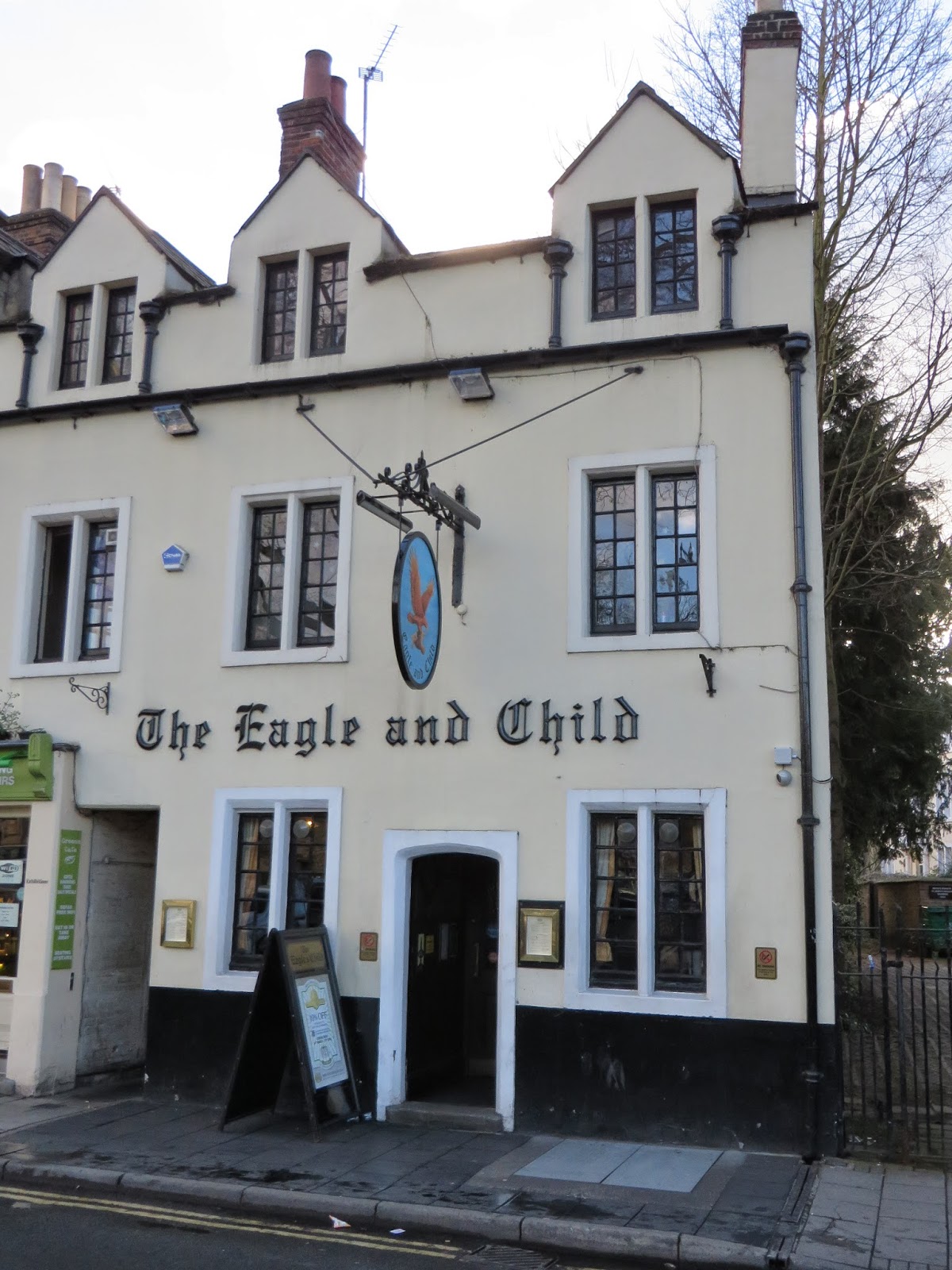
And, finally, for Morse fans, on our way out of the city, the pub where so many Oxford murders were sorted out over a pint.


Occupying equal rack space with the walking guides for Harry Potter trails, were the various editions, some with DVDs, of Morse guides.  For those of you not familiar with Endeavour Morse, he was the title character of a British crime drama shown on PBS for several seasons, based on the Inspector Morse books by Colin Dexter. This was the only site that we visited and as much as he really wanted to, Larry did not buy the guide.